
The Ramp · The Freedom Journey, Book 1
On the Second Friday of January, the Gyms Empty Out. I Can Tell You the Date Now — in October.
January 8, 2027. Researchers who track workout data call it “Quitter’s Day” — the day the resolution crowd gives up, every year, on schedule. This book is about being eleven weeks ahead of it. Not with more discipline. With a running start that begins in late October — while everyone else is still waiting for the starting gun.
On the morning of December 31, 2025, I stepped on the scale and weighed 169.2 pounds.
My first goal of the 2026 Ramp — under 170 by January 3 — was already done, three days ahead of schedule. Here’s what I wrote in my journal that morning: “Think about that. 2026 has not even begun and I’m sitting here smiling and excited because I hit my first goal.”
Now think about what everyone else was doing that same morning. Sitting around planning their resolution. Starting tomorrow — or, let’s be honest, Monday. Come Monday they’d walk into a cold gym, out of shape, carrying a month of holiday eating, and try to change everything at once.
I wasn’t standing still. I’d been building since October 14 — eleven weeks of small, almost-too-easy wins while the year wound down. I’d eaten well through December with the pumpkin pie in the plan, worked out through Christmas week, and was heading into the new year accelerating, not resting.
Five days later, on January 5, my journal entry started with three words: “I am LAUNCHED!” 166.8 pounds, moving fast, while the resolution crowd was straining against a dead car in the January cold.
That gap — between their morning and mine — wasn’t willpower. I don’t have more willpower than you. It was a calendar decision.
This page is about that decision.
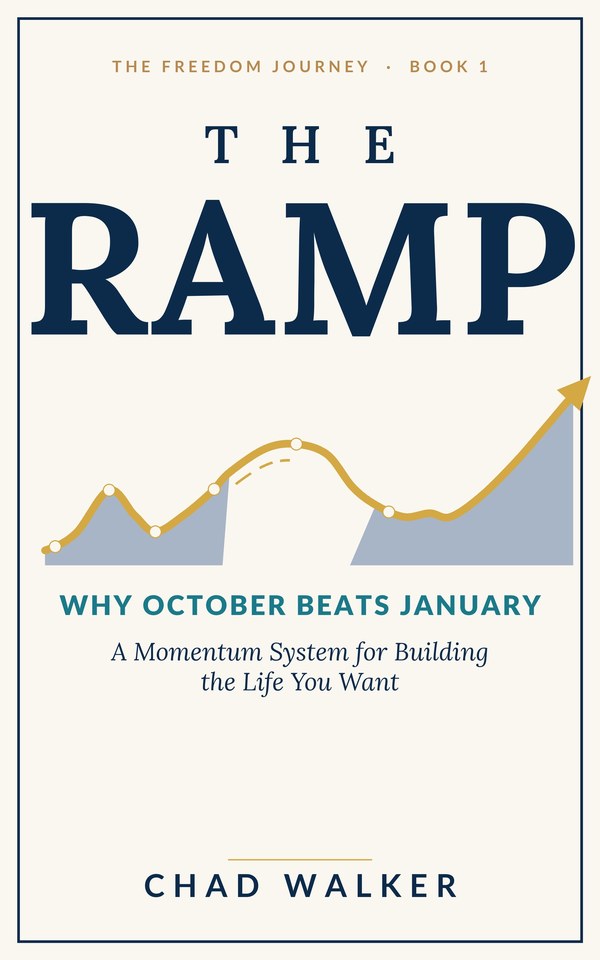
The Ramp
Why October Beats January — a Momentum System for Building the Life You Want
The Freedom Journey · Book 1 · $4.99 Kindle / $12.99 paperback · read free in Kindle Unlimited
You didn’t fail your resolutions. Your resolutions were designed to fail you.
Think about the last one. Maybe you promised to lose twenty pounds, quit drinking, train every day, finally get serious about your golf game. January 1st came, you were fired up, and for a few days — maybe a few weeks — you did it.
Then life happened. A late night. A stressful week. A cold. A trip. One missed workout became three. And the resolution that felt so important on January 1st was something you barely remembered by March.
Here’s what the honest data actually says — and it’s not the “92% of resolutions fail by February” meme. A Pew Research survey from January 2024 found that a month into the year, 87% of resolvers had kept at least some of their resolutions. People don’t fail on January 2nd. They erode — one skipped workout, one “I’ll restart Monday” at a time — until early spring there’s nothing left.
Erosion is a design problem.
A traditional resolution is a cliff: massive change, overnight, starting from a dead stop, on the one date of the year when you’re most depleted — out of shape, over-fed, over-spent, in the dark and the cold. Maybe you clear the gap once. But nobody lives their whole life hurling themselves across gaps on sheer willpower.
And every January, an entire industry sells you a bigger jump.
I’m offering you the opposite of a bigger jump.
The Ramp: a running start, on a calendar
You can learn the core idea of this book in the next ninety seconds. It’s yours either way.
If you’ve ever pushed a dead car, you already understand it. Getting a stopped car to move at all feels impossible. But once it starts to roll — even a little — every step gets easier. The car didn’t get lighter. What changed was momentum.
The new year’s resolution alternative I’ve run for eighteen years has six phases, mapped to the actual calendar: Build, Climb, Downslope, Acceleration into Launch, Soaring, Landing. The first four carry you from October into January:
INTO LAUNCH
1. Build (before the start line). Design the year on paper first: the program, the goal ladder, the calendar. Day one should be a decision you already made.
2. Climb (late October → Thanksgiving). Start eleven weeks before New Year’s, with changes so modest they feel almost too easy — a 20–30 minute workout five days a week, one food upgrade, a daily weigh-in written down without judgment. You’re not transforming yet. You’re getting the car rolling while everyone else is carbo-loading for a January they’ll abandon.
3. Downslope (Thanksgiving → Christmas). This is the phase nobody else teaches, and it’s the most disciplined stretch of my year. You don’t white-knuckle the holidays — you design them. Simple, repeatable eating on the ordinary days. Guardrails, not walls, around the feast days. Thanksgiving dinner and Christmas cookies are in the plan, which means they can’t break the plan. You pick up speed on the way down, then coast the holiday uphill on the momentum you banked.
4. Acceleration into Launch (the turn of the year). At the top of the holiday uphill, you add one short, sharp burst. For me, that’s a juice cleanse. While the resolution crowd starts from a dead stop, you hit January already moving — and you accelerate. My January 5th journal entry wasn’t “Day 1.” It was “I am LAUNCHED!”
Then Soaring carries you through the winter, roughly ninety days, while the resolution crowd quits. And Landing brings you into spring still rolling, on your way to next year’s Ramp.
That’s the whole secret: when you start matters more than how hard you try. The kids on social media figured out a version of this — they call it locking in for the last months of the year. This is that idea, built for a grown-up with a job, a mortgage, a family, and a real December — with the Downslope designed instead of pretending the holidays won’t happen.
Notice what you just did: you evaluated your next transformation using a calendar instead of a willpower test. That’s the skill. The book is the whole toolkit — and the year-long proof it works, unedited.
I journaled my entire 2026 Ramp. Including the part that makes me look bad.
While writing this book, I journaled a full year of the system — every weigh-in, every meal plan, every win, every crash. It’s woven through the chapters, dated, unedited. Three entries tell you what kind of book this is:
December 31, 2025 — 169.2 lbs. First goal hit before the year began. Eleven weeks of momentum banked while everyone else planned resolutions.
January 5, 2026 — 166.8 lbs. “I am LAUNCHED!” The Downslope worked. The January launch worked. The system did exactly what Chapters 5–8 say it does.
August 31, 2026 — the entry I could have deleted. Because here’s the truth: my summer fell apart. Work upheaval in April, stress, travel, a beach vacation where I had no intention of staying on track. The 150-pound birthday goal? Didn’t happen. The handicap that was supposed to reach 10? Went the other way — up over 14 at one point. Four months of near silence in the journal, and then this, word for word:
“I slacked over the summer. Or I enjoyed the summer. My progress was enjoying the summer, working out, not worrying about food, doing juice cleanses after bad eating periods, walking a ton of golf rounds, bringing my handicap down to 12.3 from over 14 and maintaining a consistent weight.”
Sit with that “Or” for a second. Both sentences are true — and the Ramp is why.
Look at what “falling off” actually looked like after eighteen years of ramps: I kept training. My weight held instead of ballooning. I walked mile after mile of golf and brought the handicap back into the 12s. In 2008, a summer like that would have taken me two years to undo. In 2026, the crash never came — because ramps build a floor that doesn’t break.
I could have cut that chapter. Nobody would have known. But then this would be one more transformation book by one more guy pretending to be a machine — and you’ve already read that book. It didn’t stick, remember?
The honest promise of the Ramp isn’t that you’ll never fall off. It’s that when you do, you won’t fall far.
Don’t take the book’s word for it. Watch the next Ramp happen live.
Here’s something no other book on your shelf offers.
My 2027 Ramp starts October 26, 2026 — and the journal is already running: I’m posting daily entries on My 2027 Ramp, in public, as it happens. The measurements and weigh-ins. The Downslope through the holidays. The launch. The guardrails and the wobbles. The summer where I try to finally stay locked in. If I fall off again, you’ll see that too. That’s the deal.
You’ve read what a finished year looks like above. Now you can watch the next one happen in real time — and build your own Ramp alongside mine. The timing works: start your Ramp in late October and your Downslope begins right after Thanksgiving.
Follow the 2027 Ramp — free. Drop your email and you’ll get:
- The workbook: Build Your Ramp. Find Your Balance. — A Freedom Journey Workbook — plan your own Ramp on the same calendar I’m using, free
- The monthly letter, The Freedom Journey — my month in the system, one lesson, and what’s next, once a month
- First word when something real happens — including launch-week pricing
No spam, no daily pitch. One letter a month you can check my math against, plus a note when something real happens. The daily journal lives on My 2027 Ramp, free, no signup needed. Unsubscribe anytime.
What you get in the book
- The Cliff vs. the Ramp — why resolutions fail by design, and the honest research behind erosion (Chapters 1–3)
- Why willpower isn’t your problem — decision fatigue, the 10-Minute Rule, and systems that run on a bad day (Chapter 2)
- The Morning Ramp — how to build a protected block for YOU before the world wakes up (no, you don’t need my 3:00 a.m. — you need your version) (Chapter 2)
- Identity first, outcome second — the goal-setting flip that makes habits vote for who you’re becoming (Chapter 4)
- The Ramp Framework: six phases, Build to Landing — with my actual 2026 calendar, programs, and goal ladder on one page (Chapter 5)
- Planning that beats motivation — the step-by-step plan, plus a real two-week travel stretch planned meal by meal (Chapter 6)
- The Downslope — the holiday chapter: guardrails, the Christmas-cookie crash, and how to enjoy the season without losing the year (Chapter 7)
- The Post-Holiday Launch and beyond — the post-holiday 8-week plan, plateaus, and sustaining the leap (Chapters 8–9)
- The Summer I Fell Off — the full unedited story, the diagnosis, and the climb back, written from the middle of it (Conclusion)
Read this before you buy
This book is for you if:
- You’re a busy professional — 40s or 50s, real job, real family — who’s launched and abandoned more Januarys than you want to count, and you’re tired of the restart tax.
- You respect systems, calendars, and numbers at work, and you’re ready to point that same thinking at your health.
- You’d rather follow a guy with a journal and a fall-off chapter than a guru with abs and a highlight reel.
This book is NOT for you if:
- You want maximum intensity and a drill sergeant. There are great books for that; this isn’t one, on purpose.
- You want a meal plan, a supplement stack, or medical advice. I’m a CPA, not a doctor — this book is a momentum system, and your health decisions belong with you and your physician.
- You need a 30-day miracle. The Ramp is measured in seasons and years. That’s why it works.
If you’re in the second group, save the $4.99.

The CPA who audits his own year
I’m Chad Walker, a CPA and MBA. In 2008 I weighed 256 pounds, drank too much, and could rarely break 100 on the golf course. I didn’t fix it with a resolution. I fixed it the way a finance guy fixes anything: baseline, levers, systems, compounding — applied to my body instead of a balance sheet, one ramp at a time, for eighteen years.
I’ve kept most of the weight off for years. My weight lives in its usual range of 165–175, and I’m driving back under 170 on my 2027 Ramp. The handicap is in the 12s, chasing a 10.
I’ve published my financial analysis with the misses left in since 2016. This book runs on the same rule: I show you the whole year — the goals I hit, and the summer I didn’t. My profession audits claims for a living. I just point the audit at myself.
Fair questions, straight answers
“I’ve read Atomic Habits. What’s new here?” So have I — it’s a great book, and this one stands on the shoulders of the habit science. What’s missing from the theory books is a calendar. The Ramp is the applied, dated, journaled version: when to start, how to survive December, what the year actually looks like — including the ugly parts. You’ve read why small habits work. This is the running start they were missing.
“Is this one of those 75-day challenge things?” No — closer to the opposite. Those challenges restart you at Day 1 for a missed workout. The Ramp plans your pumpkin pie into the system. All respect to the challenge crowd — but a design that treats one bad day as total failure is a cliff with extra steps, and you’ve already jumped off enough of those.
“What about the new weight-loss medications?” That’s between you and your doctor — it’s above this book’s pay grade, and I’d be out of my lane pretending otherwise. Here’s what I can tell you: whatever you and your doctor decide, somebody still has to do the daily work — train to keep muscle, eat the protein, sleep, and become the person who keeps the result. The Ramp is the operating system for every path, medicated or not.
“You fell off. Why should I follow your system?” Because I fell off and didn’t fall far — and you can check that. A lost summer cost me a few pounds and a few strokes of handicap, not the two-year collapse it caused in 2008. Perfect gurus can’t show you what their system does under failure conditions. I just did. And I’m doing it again in public, starting October 26.
“Why would I start now instead of January?” That question is the whole book. January 1 is the worst start date on the calendar: you’re depleted, it’s dark, and you’re jumping from a dead stop. Late October gives you eleven weeks of momentum and a designed Downslope through the holidays. On January 8 — Quitter’s Day — you won’t be quitting. You’ll already be launched.
$4.99. Less than the January gym visit you won’t make.
The Ramp — $4.99 Kindle / $12.99 paperback. The full framework, the 2026 journal woven through, the fall-off chapter, and an invitation at the end of the book to watch the 2027 Ramp live.
Prefer paperback? Get it on Amazon →
And Amazon’s standard return policy applies — if it’s not what you expected, return it. No theatrics.
The Ramp only works if you’re ON it before January
This is the rare book where the timing is the content.
My 2027 Ramp starts October 26. If you start yours in late October too, the calendar hands you everything: a Climb through November, a Downslope that begins right after Thanksgiving, a January launch with the crowd far behind you. Start in January instead and you’re reading a book about a running start… from a dead stop.
You don’t need to be ready today. You need the map before the road starts.
To your health, your momentum, and your freedom,
Chad — The Journey is the Destination
P.S. — It’s Friday, January 8, 2027 — Quitter’s Day. The gym parking lot is emptying out, right on schedule. You’re eleven weeks in: the workout’s done by breakfast, the holidays didn’t take anything from you they weren’t scheduled to take, and your journal has a number in it that’s moving the right direction. That morning is built in October. Follow the 2027 Ramp — and get the book: Get the book on Amazon
This page is educational, not medical advice. Chad is a CPA, not a physician; consult your doctor before changing your diet, exercise, or health regimen. Chad’s results are his own story, not a promise of yours. Disclosure: Chad is an independent BODi Affiliate — some links on FreedomJourney.life (including the Tools I Use page) are affiliate links, and he may earn a commission at no extra cost to you. He only recommends what he actually uses.